" height="32.00002387147419px" id="gZXGZYql_" transform="translate(0 0)" width="33.17407881260548px"/><path d="M 2.085 0 C 2.398 0.09 2.616 0.346 2.862 0.551 C 4.463 1.882 5.328 4.198 4.692 6.221 C 4.23 7.692 2.854 8.429 1.559 9.077 C 0.984 9.294 0.604 9.374 0 9.506 C 1.261 7.006 2.053 5.972 0.077 3.616 C 0.93 2.522 1.608 1.302 2.085 0 Z" fill="rgb(255, 255, 255)" height="9.505700000000001px" id="cmY0ROQXE" transform="translate(26.962 11.764)" width="4.902088461320112px"/><path d="M 2.786 0.079 C 4.516 -0.195 6.882 0.235 8.153 1.529 C 9.314 2.711 9.449 4.074 9.45 5.641 L 8.055 4.448 C 7.13 3.7 6.366 3.236 5.22 2.863 C 2.88 2.103 1.689 2.46 0 0.491 C 0.949 0.332 1.831 0.191 2.786 0.079 Z" fill="rgb(255, 255, 255)" height="5.640822256039236px" id="QF25qHlEr" transform="translate(19.227 1.379)" width="9.450099999999999px"/><path d="M 5.655 0 C 5.917 0.113 5.862 0.633 5.911 1.004 C 6.04 2.045 6.387 3.046 6.929 3.943 C 5.131 4.63 3.592 5.19 1.733 4.47 C 0.726 3.926 0.319 3.27 0 2.213 C 2.759 1.595 3.154 1.371 5.655 0 Z" fill="rgb(255, 255, 255)" height="4.806175899027007px" id="kqgl_H_Bc" transform="translate(10.595 23.332)" width="6.928799999999999px"/><path d="M 0 0 C 0.65 0.017 1.138 0.041 1.491 0.654 C 3.245 3.701 4.719 4.269 8.278 3.546 C 7.879 3.861 7.49 4.137 7.076 4.431 C 6.222 4.957 5.254 5.271 4.254 5.345 C 1.023 5.561 0.155 2.656 0 0 Z" fill="rgb(255, 255, 255)" height="5.356585200702476px" id="A5o1AXt5e" transform="translate(7.901 25.553)" width="8.277719999999999px"/><path d="M 1.582 0 C 1.889 0.239 1.638 0.793 1.582 1.267 C 1.337 3.362 1.705 4.763 2.654 6.583 C 2.182 7.09 1.586 7.662 1.092 8.161 L 0.98 8.239 L 0.826 8.184 C -0.289 5.719 -0.489 2.026 1.582 0 Z" fill="rgb(255, 255, 255)" height="8.23884px" id="K4X1nlNhw" transform="translate(1.373 8.977)" width="2.6544824443243806px"/><path d="M 4.879 0 L 5.154 0.02 C 5.173 0.055 5.191 0.089 5.21 0.124 C 4.076 1.11 3.076 1.841 2.163 3.07 C 0.899 4.77 1.042 6.073 0.594 7.936 C -0.71 7.351 0.477 3.227 0.911 2.183 C 1.385 1.046 3.753 0.398 4.879 0 Z" fill="rgb(255, 255, 255)" height="7.93632px" id="iX1WuEJsS" transform="translate(4.258 5.422)" width="5.209503656189256px"/><path d="M 0.891 0 C 1.252 0.397 0.785 0.972 2.043 1.993 C 3.579 2.288 5.164 2.203 6.66 1.745 C 6.19 2.232 5.777 2.59 5.268 3.03 C 5.209 3.074 5.149 3.118 5.09 3.162 C 3.442 4.368 1.179 3.903 0 2.267 C 0.206 1.503 0.429 0.651 0.891 0 Z" fill="rgb(255, 255, 255)" height="3.840138803869854px" id="EYhSkzb98" transform="translate(10.639 14.254)" width="6.660399999999999px"/><path d="M 5.7 0 L 5.862 0.129 C 5.871 0.163 5.899 0.278 5.896 0.313 C 5.7 2.553 3.858 4.223 1.838 4.943 C 1.312 5.131 0.79 5.181 0.227 5.231 C 0.062 5.156 0.114 5.18 0 5.006 C 0.058 4.568 2.368 2.938 2.85 2.535 C 3.828 1.716 4.745 0.832 5.7 0 Z" fill="rgb(255, 255, 255)" height="5.230699999999999px" id="rR3aItzbE" transform="translate(20.021 22.535)" width="5.895938333146585px"/><path d="M 1.798 0.061 C 2.392 -0.019 3.597 -0.071 4.125 0.244 C 4.638 0.944 4.484 2.507 3.821 3.106 C 3.426 3.233 3.583 3.227 3.161 3.071 C 2.323 2.592 0.895 1.713 0 1.493 C 0.65 0.799 0.954 0.488 1.798 0.061 Z" fill="rgb(255, 255, 255)" height="3.1951027036145305px" id="IMle10bWj" transform="translate(15.146 10.535)" width="4.430712176398055px"/><path d="M 0.018 0 C 0.282 0.063 1.864 1.126 2.331 1.364 C 3.197 1.804 3.346 1.876 4.34 2.173 C 4.251 2.864 4.215 3.588 4.169 4.285 C 3.236 4.526 0.886 2.837 0.45 1.956 C 0.031 1.109 -0.041 0.914 0.018 0 Z" fill="rgb(255, 255, 255)" height="4.308168324411934px" id="pheoyshQj" transform="translate(2.312 19.986)" width="4.339817240842605px"/><path d="M 0 0.027 C 0.439 0.014 1.2 -0.035 1.608 0.043 C 3.315 0.369 2.426 2.559 2.106 3.651 C 2.035 3.895 2.003 4.098 1.809 4.257 C 0.598 4.238 0.09 0.995 0 0.027 Z" fill="rgb(255, 255, 255)" height="4.257278283966036px" id="y4SOtrApl" transform="translate(22.564 5.982)" width="2.6241732006357594px"/><path d="M 2.53 0 C 3.199 0.233 4.697 4.443 1.642 3.339 C 0.801 2.889 0.575 2.665 0 1.9 C 0.709 1.252 1.74 0.538 2.53 0 Z" fill="rgb(255, 255, 255)" height="3.5230979695442386px" id="taMdD9ETv" transform="translate(22.166 17.775)" width="3.4914692646924834px"/><path d="M 1.922 0 L 2.08 0.004 C 2.445 0.65 1.939 4.817 0.934 5.155 L 0.716 5.046 C -0.285 2.784 -0.525 1.194 1.922 0 Z" fill="rgb(255, 255, 255)" height="5.154800000000002px" id="udg1KI2m_" transform="translate(17.619 21)" width="2.1985109419737654px"/><path d="M 0.58 0 C 0.964 0.148 2.564 1.331 3.056 1.648 L 1.563 3.194 C 0.988 3.708 0.635 3.938 0 4.353 C 0.455 2.537 0.619 1.856 0.58 0 Z" fill="rgb(255, 255, 255)" height="4.353200000000001px" id="hiTtHQeFA" transform="translate(20.577 20.867)" width="3.055799999999998px"/><path d="M 0.966 0 C 1.582 0.047 3.874 0.689 3.937 1.412 C 3.75 1.663 3.405 1.698 3.09 1.773 C 2.282 1.958 0.27 2.516 0 1.461 C 0.092 0.94 0.569 0.343 0.966 0 Z" fill="rgb(255, 255, 255)" height="2.0860744736189787px" id="opNh2nfUr" transform="translate(13.15 13.09)" width="3.9368px"/><path d="M 3.076 0 L 3.294 0.079 L 3.342 0.207 C 2.908 1.051 2.415 1.797 1.984 2.692 C 1.434 3.834 1.003 5.282 0.264 6.258 C 0.071 6.168 0.14 6.22 0.007 6.032 C -0.126 4.485 1.706 0.885 3.076 0 Z" fill="rgb(255, 255, 255)" height="6.258489999999999px" id="EXvZ1NrdY" transform="translate(5.901 7.504)" width="3.3417542024784233px"/><path d="M 1.308 0 C 1.265 -0.04 2.536 3.529 2.776 4.008 C 2.361 3.821 2.001 3.628 1.6 3.413 C -0.431 2.074 -0.528 1.77 1.308 0 Z" fill="rgb(255, 255, 255)" height="4.007940350226239px" id="p5Vi1bLFm" transform="translate(3.356 16.691)" width="2.7756652348500186px"/><path d="M 0.588 0 C 0.712 0.037 0.813 0.085 0.929 0.142 C 1.465 0.403 1.872 0.872 2.054 1.44 C 2.263 2.103 2.018 2.498 1.384 2.679 L 0 3.028 C 0.272 2.132 0.442 0.93 0.588 0 Z" fill="rgb(255, 255, 255)" height="3.0282500000000008px" id="V_zCzpfyC" transform="translate(25.759 6.998)" width="2.126652647905342px"/><path d="M 2.102 0 C 2.802 0.107 3.532 0.768 4.104 1.212 C 2.902 1.364 2.267 1.509 1.163 2.011 C 0.824 2.209 0.36 2.545 0 2.48 C 0.031 1.997 1.687 0.41 2.102 0 Z" fill="rgb(255, 255, 255)" height="2.4884510228622325px" id="KgZLUphip" transform="translate(11.2 5.676)" width="4.1045px"/><path d="M 4.112 0.034 C 4.292 -0.019 4.317 -0.009 4.495 0.055 L 4.521 0.223 C 4.183 0.728 0.99 2.723 0.316 3.048 C 0.138 3.125 0.208 3.106 0 3.08 C 0.021 1.932 3.087 0.317 4.112 0.034 Z" fill="rgb(255, 255, 255)" height="3.1028650031226688px" id="qq3hk8yZK" transform="translate(10.785 7.828)" width="4.521000000000001px"/><path d="M 0.141 0.077 C 0.594 0.026 1.199 -0.069 1.623 0.081 C 2.341 0.337 3.29 0.695 3.403 1.535 L 3.219 1.757 C 2.961 1.841 2.676 1.923 2.409 1.857 C 1.834 1.715 0.306 0.711 0 0.221 Z" fill="rgb(255, 255, 255)" height="1.8810147921990854px" id="JXpIE1opf" transform="translate(15.32 4.703)" width="3.402700000000001px"/><path d="M 2.72 0.04 C 3.046 -0.001 3.15 -0.015 3.474 0.019 C 3.811 0.283 3.818 0.442 3.722 0.835 C 3.251 1.286 1.932 1.16 1.172 1.177 C 0.817 1.19 0.234 1.272 0 0.991 C 0.298 0.535 2.175 0.141 2.72 0.04 Z" fill="rgb(255, 255, 255)" height="1.1983903643415106px" id="QP7_JZRtq" transform="translate(8.995 3.061)" width="3.775186453050104px"/><path d="M 0.193 0.028 C 1.37 0.006 2.502 -0.021 3.681 0.027 C 3.223 0.275 2.628 0.465 2.13 0.642 C 1.505 0.923 0.737 1.461 0.147 1.026 C -0.012 0.632 -0.1 0.34 0.193 0.028 Z" fill="rgb(255, 255, 255)" height="1.189605127915172px" id="hp2lulSqL" transform="translate(9.97 23.156)" width="3.6805205061196204px"/><path d="M 1.023 0.05 C 1.923 -0.054 2.723 0.02 3.611 0.123 C 3.049 0.38 2.64 0.478 2.041 0.637 C 1.403 0.827 0.635 0.996 0.014 0.719 L 0 0.546 C 0.275 0.253 0.639 0.176 1.023 0.05 Z" fill="rgb(255, 255, 255)" height="1px" id="BmzCHBA2O" transform="translate(12.984 20.51)" width="3.610699999999998px"/><path d="M 0.008 0 C 0.119 0.008 0.23 0.024 0.339 0.046 C 1.337 0.256 1.337 1.625 1.15 2.409 C 0.376 2.243 -0.065 0.695 0.008 0 Z" fill="rgb(255, 255, 255)" height="2.4094000000000015px" id="tsSE_BCay" transform="translate(25.73 16.309)" width="1.2458836048739457px"/><path d="M 1.441 0 C 1.549 0.032 1.598 0.072 1.694 0.13 C 1.849 0.779 0.893 1.983 0.316 2.281 C -0.694 1.786 1.001 0.423 1.441 0 Z" fill="rgb(255, 255, 255)" height="2.2813999999999997px" id="mFThfbOIR" transform="translate(24.705 11.035)" width="1.7107771516854555px"/><path d="M 0.141 0 C 1.206 0.231 0.974 1.087 0.864 1.994 C 0.686 1.994 0.499 1.983 0.321 1.976 C -0.202 1.571 0.05 0.579 0.141 0 Z" fill="rgb(255, 255, 255)" height="1.9940006770252907px" id="XFco5JL0X" transform="translate(7.804 22.531)" width="1px"/><path d="M 0.06 0.003 C 0.443 -0.011 0.745 0.019 1.018 0.308 C 1.167 0.605 1.121 0.707 1.042 1.04 C 0.621 1.007 0.402 0.977 0.105 0.675 C -0.03 0.37 -0.023 0.328 0.06 0.003 Z" fill="rgb(255, 255, 255)" height="1.0400327079323755px" id="w2Z9lCByC" transform="translate(16.894 2.666)" width="1.115859328834759px"/><path d="M 0 0.007 C 0.797 -0.068 1.456 0.475 1.871 1.112 C 1.087 1.119 0.44 0.625 0 0.007 Z" fill="rgb(255, 255, 255)" height="1.1116551820404172px" id="kl2V_0pZ0" transform="translate(19.418 7.047)" width="1.8714000000000013px"/><path d="M 0 0 L 11.42 0 L 11.42 1.52 L 6.58 1.52 L 6.58 14.24 L 4.84 14.24 L 4.84 1.52 L 0 1.52 Z M 18.664 12.94 L 19.244 12.94 L 19.244 14.24 C 18.978 14.28 18.684 14.3 18.364 14.3 C 17.284 14.3 16.704 13.807 16.624 12.82 C 15.904 13.927 14.784 14.48 13.264 14.48 C 12.131 14.48 11.238 14.22 10.584 13.7 C 9.944 13.167 9.624 12.42 9.624 11.46 C 9.624 9.593 10.898 8.527 13.444 8.26 L 14.924 8.1 C 16.004 7.98 16.544 7.507 16.544 6.68 C 16.544 6.107 16.364 5.693 16.004 5.44 C 15.658 5.187 15.064 5.06 14.224 5.06 C 13.331 5.06 12.684 5.213 12.284 5.52 C 11.898 5.813 11.678 6.34 11.624 7.1 L 10.024 7.1 C 10.158 4.82 11.558 3.68 14.224 3.68 C 16.811 3.68 18.104 4.68 18.104 6.68 L 18.104 12.44 C 18.104 12.773 18.291 12.94 18.664 12.94 Z M 13.344 13.12 C 14.198 13.12 14.944 12.86 15.584 12.34 C 16.224 11.833 16.544 11.107 16.544 10.16 L 16.544 8.94 C 16.251 9.167 15.798 9.313 15.184 9.38 L 13.684 9.56 C 12.818 9.667 12.198 9.867 11.824 10.16 C 11.464 10.453 11.284 10.873 11.284 11.42 C 11.284 11.953 11.458 12.373 11.804 12.68 C 12.151 12.973 12.664 13.12 13.344 13.12 Z M 25.314 3.68 C 26.767 3.68 27.934 4.167 28.814 5.14 C 29.681 6.127 30.114 7.44 30.114 9.08 C 30.114 10.707 29.681 12.013 28.814 13 C 27.934 13.987 26.767 14.48 25.314 14.48 C 23.834 14.48 22.681 13.907 21.854 12.76 L 21.854 18.16 L 20.254 18.16 L 20.254 3.92 L 21.774 3.92 L 21.774 5.52 C 22.601 4.293 23.781 3.68 25.314 3.68 Z M 25.114 13.04 C 26.114 13.04 26.914 12.68 27.514 11.96 C 28.127 11.227 28.434 10.24 28.434 9 C 28.434 7.787 28.134 6.84 27.534 6.16 C 26.947 5.467 26.141 5.12 25.114 5.12 C 24.101 5.12 23.294 5.467 22.694 6.16 C 22.094 6.853 21.794 7.827 21.794 9.08 C 21.794 10.32 22.094 11.287 22.694 11.98 C 23.294 12.687 24.101 13.04 25.114 13.04 Z M 42.472 3.68 C 43.592 3.68 44.458 4.007 45.072 4.66 C 45.698 5.3 46.012 6.16 46.012 7.24 L 46.012 14.24 L 44.412 14.24 L 44.412 7.4 C 44.412 5.88 43.692 5.12 42.252 5.12 C 41.492 5.12 40.858 5.427 40.352 6.04 C 39.858 6.64 39.612 7.493 39.612 8.6 L 39.612 14.24 L 38.012 14.24 L 38.012 7.4 C 38.012 5.88 37.292 5.12 35.852 5.12 C 35.105 5.12 34.478 5.427 33.972 6.04 C 33.465 6.64 33.212 7.493 33.212 8.6 L 33.212 14.24 L 31.612 14.24 L 31.612 3.92 L 33.132 3.92 L 33.132 5.44 C 33.812 4.267 34.805 3.68 36.112 3.68 C 37.658 3.68 38.718 4.327 39.292 5.62 C 40.012 4.327 41.072 3.68 42.472 3.68 Z M 52.581 8.2 L 54.041 3.92 L 55.781 3.92 L 51.421 15.86 C 51.114 16.727 50.694 17.333 50.161 17.68 C 49.627 18.04 48.927 18.22 48.061 18.22 C 47.767 18.22 47.447 18.2 47.101 18.16 L 47.101 16.82 L 48.041 16.82 C 48.961 16.82 49.587 16.393 49.921 15.54 L 50.281 14.58 L 46.401 3.92 L 48.161 3.92 L 49.621 8.22 C 50.141 9.74 50.634 11.227 51.101 12.68 C 51.487 11.44 51.981 9.947 52.581 8.2 Z" fill="rgb(3, 3, 3)" height="18.220000076293946px" id="glUGDzk9A" transform="translate(38.574 9.76)" width="55.78079879760742px"/></svg>)



" height="21.95706114703747px" id="qM5sFNDIS" transform="translate(3.459 1.023)" width="17.081538493872166px"/></svg>)
" height="16.041644077985946px" id="vPwWmgEb7" transform="translate(2.375 4.207)" width="19.249983003077222px"/></svg>)
" width="20px"><path d="M 0 20 L 0 0 L 20 0 L 20 20 Z" fill="transparent" height="20px" id="Iu2kCeaUT" width="20px"/><path d="M 4.531 6.206 L 0.253 6.206 L 0.253 19.08 L 4.531 19.08 Z M 2.393 4.449 C 3.884 4.449 4.813 3.46 4.813 2.224 C 4.785 0.961 3.884 0 2.421 0 C 0.957 0 0 0.961 0 2.224 C 0 3.46 0.929 4.449 2.364 4.449 Z M 11.178 19.08 L 11.178 11.89 C 11.178 11.506 11.206 11.121 11.319 10.847 C 11.628 10.077 12.333 9.281 13.515 9.281 C 15.063 9.281 15.682 10.462 15.682 12.193 L 15.682 19.08 L 19.961 19.08 L 19.961 11.698 C 19.961 7.744 17.85 5.904 15.034 5.904 C 12.765 5.904 11.747 7.152 11.178 8.029 L 11.178 6.206 L 6.899 6.206 C 6.956 7.414 6.899 19.08 6.899 19.08 Z" fill="rgb(0, 0, 0)" height="19.079659942779543px" id="hzLTqQuQE" transform="translate(0.02 0.461)" width="19.960870207061767px"/></g></svg>)
" height="18px" id="TrPl6m2Z8" transform="translate(1.75 3)" width="20.5px"/></svg>)
Key Takeaways (TL;DR):
Superior Conversion Rates: DM-sourced leads convert at 40–70%, significantly outperforming the 5–15% typical of cold bio-link clicks due to existing context and perceived reciprocity.
The Micro-Promise Framework: Successfully capturing emails in DMs requires offering a specific, immediate value (like a PDF or template) as a delivery mechanism rather than a generic newsletter invite.
Strategic Automation: While manual DMs preserve the highest trust, keyword triggers and comment-to-DM flows are essential for scaling, provided they include human-like 'throttling' and contextual follow-ups.
Attribution is Critical: Subscribers should be tagged by their source (e.g., 'DM-sourced') to ensure they receive email sequences that reference the specific conversation or post that led to their sign-up.
Compliance & Deliverability: Creators must include explicit consent language at the point of capture and maintain records to satisfy GDPR and CAN-SPAM regulations.
Balanced Sequencing: Use a two-step approach—acknowledge the user first, then offer the asset—to avoid appearing transactional or spammy.
Why Instagram DMs beat the bio link for warm email capture — and why that advantage isn't automatic
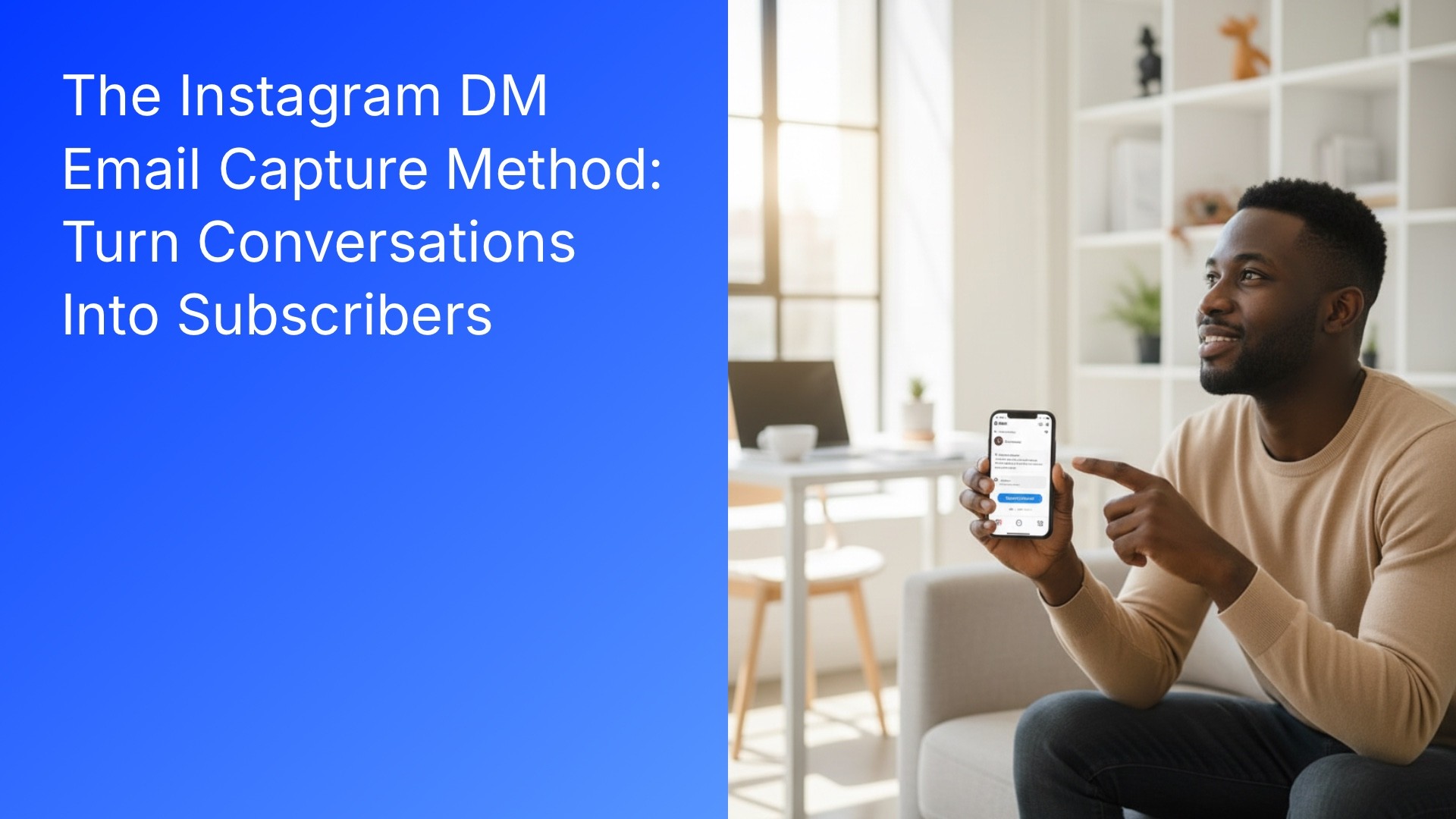
Creators who answer a steady stream of direct messages already sit on a high-intent channel. People slide into DMs after watching your Reels, reacting to a story, or commenting on a post. That prior context — a recent attention event, an expressed curiosity, or a micro-commitment like a comment — is what makes Instagram DM email capture so effective. Practically, DM-sourced prospects convert at radically different rates than cold visitors who click your bio link: the observed range for DM-to-email subscriber rate is roughly 40–70%, versus a cold bio-link click conversion rate of 5–15%. Those ranges are not universal, but they explain why prioritizing DM funnels changes the economics of audience monetization.
Why the gap? Two concrete behavioral mechanics. First: attention momentum. A DM conversation preserves context. When you reply to a question about a post, the prospect is still in the mindset that produced the question. Second: perceived reciprocity. DM conversations feel like 1:1 help — and people reciprocate by exchanging their email when they expect value back (a guide, a swipe file, a waitlist invite). Both mechanics are psychological, not algorithmic. They don't require a perfect product page or a fast landing page. They require timing, framing, and clear value.
But the advantage is fragile. You can squander it in several ways: asking for an email too early, using generic language, or routing people to a slow or irrelevant sign-up page. The result is a fractured experience: a warm DM turns into a dead-end link. That failure mode is why systems matter — not because technology is the magic, but because a consistent handoff preserves momentum.
There are trade-offs to accept. Manual DM asks scale poorly but maintain context; automated keyword triggers scale but introduce impersonality and compliance pitfalls. Neither is inherently better. The practical question for creators is: which parts of the conversation must remain human to keep a 40–70% capture rate, and which parts can be automated without breaking trust?
How to ask for an email in a DM without sounding awkward — scripts, sequencing, and timing
Asking for an email in a private message feels awkward for many creators because it blurs the line between conversation and capture. The correct approach is less about sleight and more about permission and narrow promises. Keep the ask small, explicit, and immediate in benefit.
Structure the micro-conversation like this: 1) acknowledge context, 2) signal permission to share, 3) offer a single, specific reward, 4) provide the capture mechanism. Short script templates below are practical and adaptable.
Example scripts that work (pick tone to match your audience):
After a comment asking for a template: "I can send you the exact caption template I used. Want me to DM it or should I email the file so you can download it?"
When someone says they want deeper help: "I have a 1-page checklist that fixes that issue fast. I can paste it here or email the downloadable version — which do you prefer?"
If a follower is praise-heavy but vague: "Love that. If you want the walkthrough I mentioned, I can send the PDF. Drop your email and I’ll shoot it over." (Use sparingly — better to ask permission first.)
Why these work: each script reduces friction by giving the recipient a choice (DM vs email); it frames email as a delivery mechanism for a file or tool; and it keeps the ask tightly coupled to a promised outcome. Notice the pattern: the ask appears only after value is implied. Jumping to "subscribe to my list" without an immediate exchange breaks the social contract.
Timing matters. If the DM thread is short — one question, one answer — ask within the same message pair. For multi-message help (a troubleshooting thread), wait until you've given meaningful value. When someone has already invested time explaining their situation, they're much likelier to accept an email-based follow-up.
Handling objections: expect hesitation. An effective response to resistance is a tiny reciprocity move: "Totally get it — want me to drop the key points here and email the full version in case you want the PDF later?" That keeps the conversation human and preserves the path to capture without sounding transactional.
Operational tip: create three canned DM responses saved in Instagram quick replies (two human-sounding, one utility-focused). Rotate them slightly. Reuse only the skeleton; humanize before hitting send.
Keyword-trigger DMs and the comment→DM funnel: design patterns, scale, and where it falls apart
Two automation primitives dominate the DM capture space: keyword-trigger DMs and comment-to-DM flows. Both are high-volume strategies for getting people into your DM inbox where the real conversion happens. They are useful, but the psychology of the person on the receiving end changes when the first touch is automated.
Mechanics: with keyword-trigger DMs, you publish a post that invites a specific word in the comments (e.g., "Comment 'GUIDE'"). A vendor or Instagram's native automation watches comments and auto-sends a DM containing a next step, usually a short message plus a link. In comment-to-DM formats, that DM often contains an opt-in link or instructions to reply “done” to receive the asset.
Performance signals people report: a well-targeted comment-trigger post can generate anywhere from ~50 to 500+ DMs depending on reach and relevance. Those DM volumes create two challenges: inbox triage and response latency. Both damage conversion if mishandled.
Where it breaks
Auto-DMs that lead directly to a generic landing page. People expect personalized follow-up. A generic squeeze page breaks perceived reciprocity.
High latency. When hundreds of DMs arrive and no one replies for days, initial interest evaporates. The person who commented sees silence, assumes the offer expired, and moves on.
Platform rate limits and spam detection. Instagram can restrict or penalize accounts that send too many identical DMs in a short window. That risk increases if automation sends identical messages to dozens of recipients.
Mitigations: batch personalization, staged automation, and pragmatic throttling. Instead of sending the same long message to everyone, use a two-step automation: auto-DM with a short, context-specific line, then a manual or semi-automated follow-up that includes the opt-in link. For example, the trigger DM says, "Thanks — I'll send the guide in 15 minutes. Reply 'yes' if you want the downloadable PDF." That small delay lets you filter and prioritize replies and reduces the appearance of a mass broadcast.
Scaling rule of thumb (empirical): if you expect under 200 DMs from a post, you can reasonably manage manual follow-up with help (an assistant or part-time moderator). Above that, you must design automation to handle triage without making people feel ignored. There are ways to automate responsibly, and ways that get accounts flagged.
Social-proof amplifier: the comment-to-DM format also feeds future posts. When followers see replies or saved posts, perception of scarcity and legitimacy increases. Use that to guide which posts you automate and which you keep personal.
Finally, not all keyword-trigger traffic has equal intent. A comment-driven DM is often a lower-barrier micro-commitment than someone who DMs directly with a specific problem. Treat them differently in your follow-up sequence.
What to say in a DM that reliably converts: scripts, micro-promises, and sequencing for 1:1 and semi-automated flows
Successful DM copy shares three properties: clarity, immediacy, and a single call-to-action. It should be readable in one glance and tell the recipient exactly what they'll get next. Below are practice-tested micro-promises and sequences you can adapt.
Micro-promises (examples)
"A 3-step checklist that removes friction in five minutes." — useful for how-to or growth creators.
"A one-page template you can copy/paste into your caption." — compelling for social or freelance creators.
"A 2-minute video breakdown to fix that exact mistake." — high perceived value for service providers.
Two conversion sequences
Sequence A — Human-first (higher conversion):
User DMs a question or comments and receives a short, helpful response from you.
You offer the asset: "I can email that PDF so it’s easy to save — want it?"
If yes: you request the email and offer an immediate small sample in the DM to maintain reciprocity.
User opts in, receives email; you follow-up with a 1–2 message onboarding sequence keyed to their question.
Sequence B — Semi-automated (scales better, slightly lower conversion):
User comments a keyword and receives an auto-DM: "Thanks — reply 'send' and I’ll share the guide." (Short, contextual.)
After reply 'send', the automation replies with the Tapmy link (see tracking section) and a short consent phrase: "Click the link to get the PDF — we’ll email you the download and occasional updates."
User clicks link, opts in, and is tagged as DM-sourced for follow-ups.
DM copy examples that actually get responses:
"Which part of this feels hard for you: A) getting started or B) keeping it consistent? Send A or B and I'll share the checklist that matches." (Two-choice micro-commitment is low-friction.)
"If you want the template, drop your email and I’ll send it over. If you'd rather I paste the basics here, say 'paste'." (Gives control.)
Psychology note: framing the email as a delivery mechanism (for a PDF, template, or video) leads to higher acceptance than framing it as "join my list." People consent to a transactional exchange more readily than a subscription promise.
Tracking attribution: why tagging DM-sourced subscribers matters and how the monetization layer fits in
Attribution in this workflow is simple in concept and messy in practice. The goal is to know which subscribers came from DM conversations versus bio links, story links, or other sources. Why care? Because the subsequent email sequence should reflect the origin — a DM-sourced lead expects contextual follow-up tied to the conversation they had.
Two common attribution failure modes
All subscribers lumped together. You can't tell which sequences are driving revenue or re-engagement because the list lacks origin metadata.
Manual tagging at scale. If you manually tag subscribers based on reading DMs, you quickly hit human limits and introduce errors.
Tapmy's link infrastructure addresses this by providing link-level attribution that plugs into the broader monetization layer — conceptually: attribution + offers + funnel logic + repeat revenue. In practice, that means dropping a Tapmy link into a DM so that when the recipient clicks and opts in, the system automatically tags them as "DM-sourced" and preserves the conversation context for subsequent personalization.
Why automatic tagging matters beyond segmentation: it enables sequence branching. For example, a new DM-sourced subscriber might get a welcome sequence referencing the exact post or DM topic that led them to opt in. A bio-link subscriber receives a different sequence that assumes they started cold. That preserves relevance and increases downstream conversions.
Assumption | Reality | Implication for creators |
|---|---|---|
All opt-ins are equal | Origin impacts expectation and engagement | Tag at capture to route to the right sequence |
Manual tagging is accurate | Human error and scale limits introduce noise | Automated attribution reduces mistakes and enables reporting |
DMs are private and separate | DM context is valuable for personalization | Preserve conversation metadata with each tag |
Operationally, the easiest path is to ensure the opt-in link you send in DMs supports UTM-like or tag parameters that your email provider captures at signup. Tools that offer link-level tagging reduce the need for manual entry and make attribution reportable inside your CRM. If you use a link provider as part of a monetization layer, it can also decide which email sequence or offer to trigger based on the tag.
One more practical point: don't assume users will click from DM to opt-in immediately. Some will prefer you to paste the asset in chat; others will want an email because they need a downloadable file. Your tracking plan must accept both outcomes — tag the email opt-ins automatically, and keep a simple manual tag workflow for those who receive the asset in-chat but later subscribe.
For broader context on converting Instagram into a predictable list-building channel, see the parent guide on bridging Instagram to email: Instagram to Email: the complete bridge.
Compliance, deliverability, and common failure modes when collecting emails in DMs
Collecting emails via Instagram DMs happens in a privacy-forward environment that also triggers regulatory obligations. Two regimes matter most for creators: GDPR (for EU residents) and CAN-SPAM (for U.S.-based commercial email). There are practical, legal, and deliverability implications to get right.
Compliance framework for DM email collection (practical checklist)
Consent language at point of capture: include a brief line that explains what they will receive. Example: "We'll email you the PDF and occasional updates about related resources. Reply 'yes' or click the link to opt in."
Double confirmations where appropriate: GDPR often expects affirmative consent. A confirmation email that reiterates opt-in and offers an easy unsubscribe link reduces legal risk.
Record-keeping: keep a timestamped record of consent and the message that secured it (save the DM text or the opt-in form log).
Unsubscribe management: every marketing email must include a functioning unsubscribe link, and processing should be immediate.
Technically, the minimum viable consent phrase is short and explicit. Avoid burying consent within long paragraphs or implied language. If you use automation to send a link, the landing page should restate the consent and provide access to your privacy notice (linking to a publicly accessible policy). That page is the canonical record of the opt-in terms.
What people try | What breaks | Why |
|---|---|---|
Mass auto-DMs with the landing page link | Spam flags, account restrictions, angry followers | Identical messages + scale trigger platform safety systems and irritate users |
Relying solely on DM transcripts for consent proof | Hard to audit and inconsistent records | DMs can be edited or lost; forms centralize consent logs |
Sending files inside DMs without email capture | Missed downstream monetization and poor tracking | In-chat delivery avoids opt-in capture and attribution |
Deliverability considerations: DM-sourced subscribers often have higher engagement, which helps email deliverability. But the initial email must meet basic deliverability hygiene: clear from-name, consistent sending domain, and an explicit unsubscribe link. If you tag DM-sourced subscribers differently, track open and click rates separately; DM-origin sequences should show better early engagement, and if they don't, investigate content mismatch or stale interest.
Automation risks and when to avoid them
Automation reduces friction but also reduces nuance. Two key risks: 1) sending the wrong message at volume, and 2) violating platform rules. If your audience expects a personal tone (e.g., micro-niche coaching), over-automation will kill conversion and your brand perception. If Instagram account health matters to your business — and it usually does — prioritize conservative automation patterns that mimic human pacing.
Decision matrix: when to use automation versus manual follow-up
Scenario | Use manual follow-up | Use automation (with guardrails) |
|---|---|---|
High-ticket offers or 1:many coaching | Yes — personalization matters | No |
Low-friction lead magnets and large comment volumes | No — impossible to scale | Yes — but include throttling and short context messages |
Regulated industries or sensitive data | Yes — to ensure compliance | Only under legal review |
Finally, respect the user experience. If someone signs up via DM, it is still an inbound marketing touch — be prompt, helpful, and transparent. Overpromising in the initial DM and underdelivering in the email sequence is a common failure that reduces long-term list value.
Operational playbook: combining DM capture with lead magnet delivery and tracking at scale
This section walks through a practical small-team workflow that preserves conversion rates while scaling.
Roles and simple tooling
Creator — writes the posts, shapes voice, does higher-touch DMs.
Moderator — triages initial DM replies and filters high-intent leads to the creator.
Automation tool / link provider — sends opt-in links, captures tags, and triggers sequences.
Email provider — hosts the form, delivers the lead magnet, and runs sequences.
Step-by-step flow for a comment-trigger campaign
Publish post with a clear comment trigger (single word). Use a short caption that sets expectation.
Automation sends a brief DM within acceptable platform limits: "Thanks — reply SEND and I'll share the guide." Keep it personalized if possible (include first name token).
When a user replies SEND (or clicks the DM link), present a Tapmy-style link that routes them to a minimized opt-in form. The link captures "dm_source" tag automatically.
User opts in, receives the lead magnet via email, and is tagged in the CRM as DM-sourced. An initial welcome email references the post or the conversation that prompted the opt-in.
Moderator reviews the day's DM replies and escalates any high-intent leads for a personal follow-up within 24 hours.
Why this works: it keeps the initial DM short and human-feeling, funnels the formal opt-in through a tracking-friendly page, and preserves personalization where it matters — the follow-up.
Linking other content to support the funnel: use related resources to reduce friction and increase trust. Examples: a follow-up story that reminds people the guide is in their email (helps deliverability), or a pinned highlight showing social proof. For tactical advice on configuring the bio link alongside DM funnels, see how to optimize your Instagram bio link and an explainer of what a link-in-bio page does: what is a link-in-bio page and how it affects signups.
Use the wider content ecosystem. If your lead magnet fits other formats, cross-link to related posts to create a multi-channel pathway: lead magnet ideas and mechanics are covered in Instagram lead magnets that actually get email signups, and if you use Stories to push people into DMs as a warm intro, see using Instagram Stories to build your email list.
One more operational hygiene tip: label your assets and sequences with the originating post ID or campaign name at capture time. That small discipline makes post-campaign analysis feasible and prevents the common "we don't know where these subscribers came from" problem.
FAQ
How do I phrase consent in a DM so it’s GDPR compliant?
Keep it explicit and short: state what the person will receive and who will send it. Example: "Clicking the link will email you the PDF and occasional related updates from [Your Name/Brand]. You can unsubscribe anytime." Follow with a confirmation email that repeats the consent and provides an unsubscribe link. Save the DM text or the opt-in form log as your record of consent. If you anticipate EU residents at scale, use a form that records IP and timestamp to be safer.
Should I ever paste the whole lead magnet directly into a DM instead of collecting email?
It depends on your goals. Pasting short, high-impact snippets in-chat builds goodwill and can increase long-term trust, but it forfeits attribution and follow-up opportunities. If the asset is a downloadable file or a resource you’ll want to use in an email sequence, insist on email delivery. A hybrid approach often works: paste a short tip in-chat to help immediately, then offer the downloadable version via email.
How do I avoid Instagram flagging my automation when I run a comment-trigger campaign?
Throttle your messages and vary the text. Use short, context-aware auto-DMs rather than long, identical pitches. Include slight personalization tokens (first name, post reference) where the automation allows. Spread high-volume campaigns over time or coordinate them with an assistant so replies can be staggered. If using a third-party tool, confirm it follows platform rate guidelines and avoid sending attachments or excessive links in the initial DM.
What metrics should I track to evaluate whether DMs are building a valuable email list?
Track DM-to-email conversion rate, the open and click rates for DM-tagged sequences versus bio-link sequences, and downstream revenue per subscriber for each origin. Also monitor response latency (time between DM and opt-in) and unsubscribe rates. These metrics tell you whether DM-sourced contacts are genuinely more engaged or whether a mismatch in expectations is causing rapid drop-off.
When is automation the wrong choice for DM email capture?
If your brand depends on high-touch personalization or if your offers are high-ticket and require nuanced qualification, heavy automation is usually detrimental. Also avoid automation if you can't monitor inbox volume and reply within a reasonable timeframe — silence damages trust faster than imperfect human replies. Use automation only to reduce routine work while preserving human checks for edge cases.
Additional resources that expand on adjacent tactics and channels: pairing DM capture with cross-platform bio strategies (TikTok link-in-bio strategy), turning content into revenue (content-to-conversion framework), and broader bio-link design patterns (what is a bio link and how it works).
For role-specific guides: creators and influencers who rely on DMs can find platform-specific recommendations at Creators and Influencers. Freelancers and business owners running service-based funnels may want the operational playbooks at Freelancers and Business Owners. Experts building repeatable paid offers can see relevant strategies at Experts.
Further tactical references for multi-platform funneling and conversion optimization include conversion-ready bio CTAs (17 link-in-bio CTAs), using duet/stitch strategies to grow reach (TikTok duet & stitch strategy), and analytics playbooks that reveal what predicts future engagement (TikTok analytics deep dive). If you need lightweight tools to test link-driven DM funnels, see the comparison of free bio-link tools (best free bio-link tools in 2026), and for pricing and offer framing guidance, read about pricing psychology for creators (pricing psychology).